When Pocket Doors Make Sense: Understanding Disappearing Doors in Modern Homes
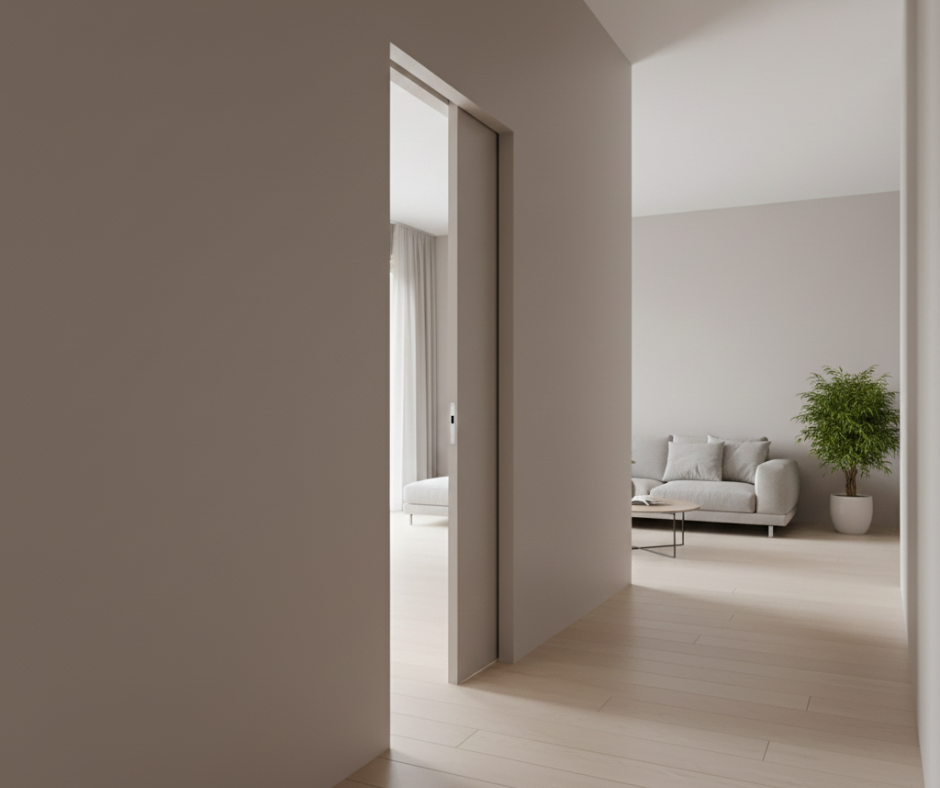
Pocket doors rarely draw attention to themselves—and that is precisely their appeal. In contemporary interiors, where openness and visual calm are increasingly valued, doors that disappear entirely can transform how spaces are experienced.
Rather than acting as features, pocket doors are designed to retreat. When open, they remove visual barriers, allowing rooms to flow together with minimal interruption. This article looks closely at when pocket doors make sense, how designers use them, and the contexts in which they perform best.
What Defines a Pocket Door
Unlike surface-mounted sliding doors, pocket doors slide into a concealed wall cavity. When open, they leave no visible trace—no panels, no tracks, no visual interruption.
This characteristic places pocket doors firmly in the category of architectural solutions rather than decorative ones. Their success depends less on appearance and more on how effectively they support the spatial logic of a home.
The Appeal of Visual Quietness
One of the primary reasons designers specify pocket doors is visual restraint. In minimalist and contemporary interiors, reducing visual clutter helps spaces feel calmer and more expansive.
By disappearing completely, pocket doors allow:
Clean wall planes
Uninterrupted sightlines
Greater emphasis on light and proportion
This preference for visual quietness is often contrasted with more expressive systems, especially when comparing sliding systems like barn doors and pocket doors in modern living spaces.
Where Pocket Doors Work Best
Pocket doors tend to perform best in spaces where flexibility is required without visual compromise.
Common applications include:
Bathrooms adjoining bedrooms
Home offices within open-plan layouts
Closets and utility rooms
Small apartments where every inch counts
In these contexts, the ability to close a room when needed—then erase the boundary entirely—offers both function and elegance.
Installation Considerations Designers Don’t Overlook
Despite their advantages, pocket doors are not a universal solution.
They require clear wall cavities, free of plumbing, wiring, or structural elements. For this reason, designers often favour pocket doors in new builds or major renovations, where wall construction can be planned accordingly.
In existing homes, installing a pocket door may involve opening walls and reframing—an investment that must be weighed against the spatial benefits gained.
Privacy, Acoustics, and Everyday Performance
Pocket doors generally offer better sound and light control than surface-mounted sliding doors, thanks to their enclosed design. While not always equivalent to hinged doors, they provide sufficient separation for many private spaces.
Designers often consider pocket doors a middle ground—more discreet than barn doors, yet more flexible than fixed partitions.
These performance considerations become clearer when viewed alongside broader discussions about the pros and cons of barn doors and other interior door systems.
Design Integration in Modern Interiors
Visually, pocket doors are meant to disappear. Flush finishes, minimal reveals, and careful detailing help them blend seamlessly into surrounding walls.
When closed, they should feel intentional. When open, they should feel absent.
This balance is what allows pocket doors to support contemporary interiors without competing for attention.
When Pocket Doors May Not Be Ideal
Pocket doors are less suitable in situations where:
Walls cannot be altered
Frequent maintenance access is required
Maximum sound insulation is essential
In such cases, hinged or surface-mounted sliding doors may offer more practical solutions.
Conclusion
Pocket doors excel not by standing out, but by stepping aside. In modern homes that prioritise openness, adaptability, and visual calm, they offer a refined way to manage boundaries without permanence.
As with any design choice, their success lies in context. When planned thoughtfully, pocket doors can quietly enhance how spaces are lived in—by knowing when to appear, and when to disappear.
Recent Comments