Glass Sliding Doors in Modern Homes: Transparency as a Design Tool
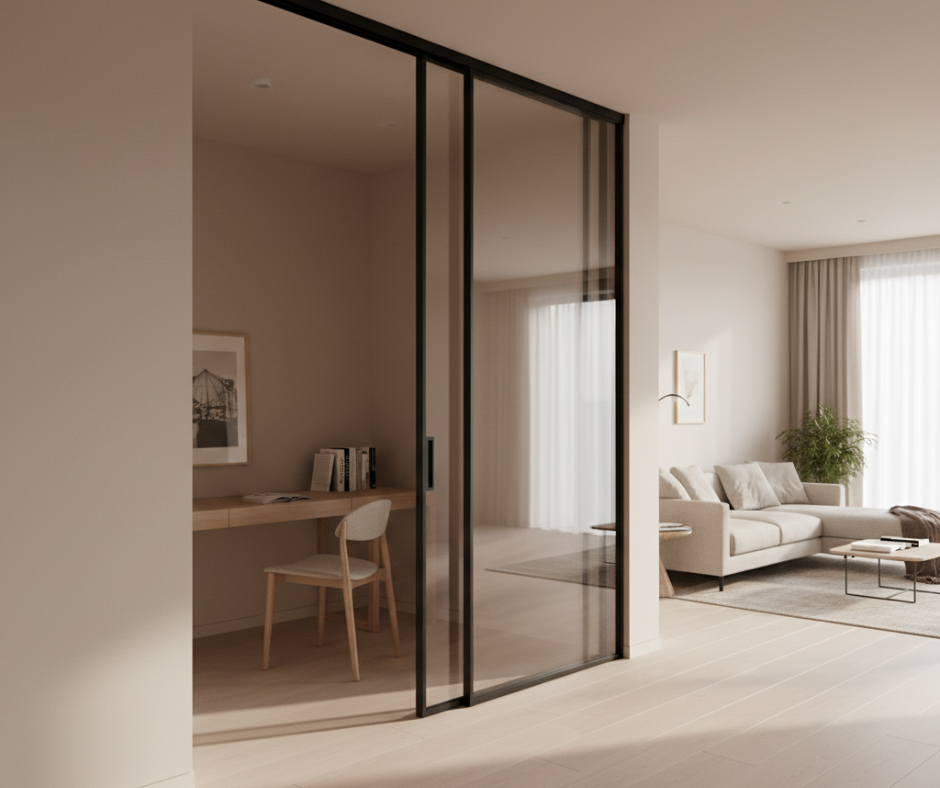
Glass sliding doors have quietly shifted from being purely functional to becoming deliberate design tools in modern homes. Rather than dividing spaces outright, they redefine how rooms connect—allowing light to travel, boundaries to soften, and interiors to feel more expansive without sacrificing separation.
Designers increasingly turn to glass sliding doors not to make statements, but to solve spatial challenges with restraint. This article explores how glass sliding doors are used in contemporary interiors, where they perform best, and what they contribute beyond aesthetics.
What Makes Glass Sliding Doors Distinct
Unlike solid doors, glass sliding doors prioritise transparency. Their defining quality is not movement alone, but visibility—maintaining visual continuity even when spaces are technically separated.
Whether framed minimally or designed to blend into surrounding architecture, glass sliding doors sit at the intersection of openness and control. They allow rooms to feel connected while still offering functional separation when required.
Light, Flow, and Spatial Perception
One of the strongest arguments for glass sliding doors is their ability to manage light. In homes where natural daylight is limited or unevenly distributed, glass doors help extend brightness deeper into interior spaces.
This quality is especially valued in:
Open-plan living areas
Home offices
Dining spaces adjoining kitchens
This balance between separation and openness becomes clearer when considering how different sliding systems function, particularly in discussions around when pocket doors make sense for maintaining visual calm.
Where Glass Sliding Doors Work Best
Glass sliding doors tend to perform best in spaces where privacy is moderate rather than absolute.
Common applications include:
Home offices within shared living areas
Dining rooms that benefit from acoustic separation without losing light
Transitional zones between living spaces
In these contexts, glass doors offer a sense of enclosure without isolating rooms entirely.
Privacy and Acoustic Considerations
While glass sliding doors excel visually, they come with trade-offs. Transparency naturally limits privacy, and sound insulation varies depending on framing and glazing thickness.
Designers often address these concerns through:
Frosted or textured glass
Curtains or soft furnishings nearby
Strategic placement away from high-privacy zones
These limitations echo broader design trade-offs seen across sliding systems, similar to those discussed in the pros and cons of barn doors and other interior door choices.
Design Integration in Contemporary Interiors
In modern homes, glass sliding doors are most successful when their detailing is understated. Slim frames, neutral finishes, and careful alignment with wall planes allow the doors to complement rather than dominate the space.
When over-designed, glass doors can feel commercial. When restrained, they reinforce the architectural language of the home.
Maintenance and Long-Term Use
From a practical standpoint, glass sliding doors require regular cleaning to maintain their clarity. Fingerprints, dust, and smudges are more visible than on solid panels.
That said, well-installed glass sliding systems tend to age gracefully, particularly when hardware and framing are chosen for durability and simplicity.
When Glass Sliding Doors May Not Be Ideal
Glass sliding doors are less suitable in spaces where:
Complete visual privacy is required
Strong acoustic separation is essential
Visual calm depends on solid boundaries
In these cases, solid sliding or hinged doors may provide more appropriate solutions.
Conclusion
Glass sliding doors succeed not by hiding boundaries, but by redefining them. In modern homes that value light, flow, and visual connection, they offer a refined alternative to solid partitions.
Used thoughtfully, glass sliding doors become less about division and more about balance—allowing spaces to remain distinct without feeling disconnected
Recent Comments