Barn Door vs Pocket Door: A Thoughtful Comparison for Modern Living Spaces
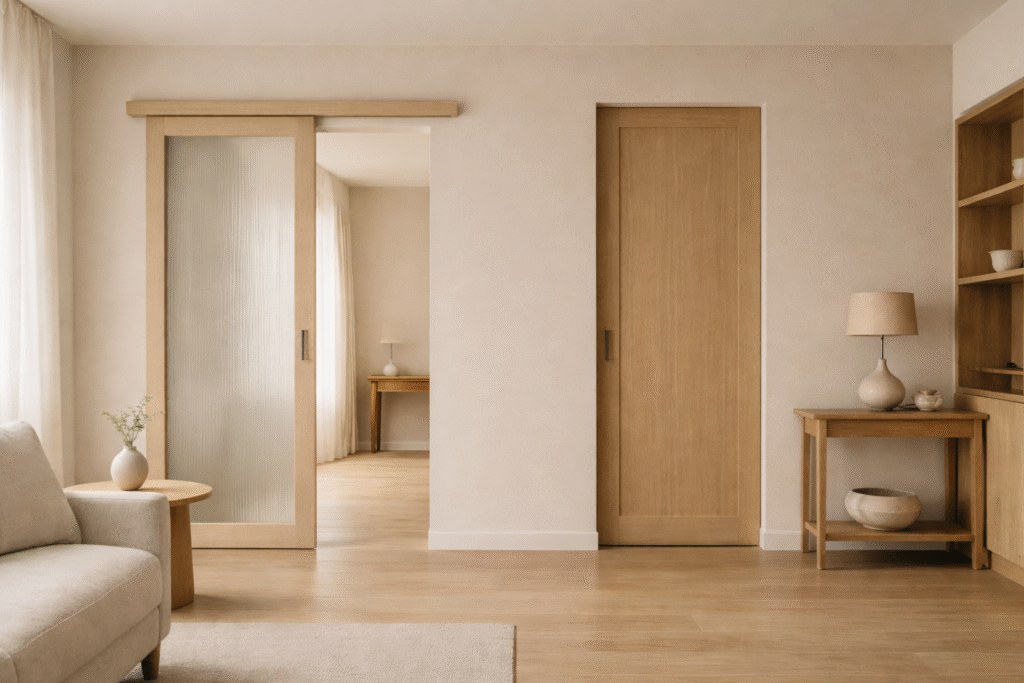
Sliding doors have become a defining feature of modern homes. As floor plans grow more open and living spaces more fluid, homeowners and designers alike are increasingly drawn to door systems that prioritise flexibility over permanence.
Among the most frequently considered options are barn doors and pocket doors. At a glance, both appear to solve the same problem: separating spaces without the swing clearance of a traditional hinged door. In practice, however, they create very different experiences.
Rather than asking which door is better, interior designers tend to ask a more revealing question: how should this space feel when the door is open, and how should it function when closed? The answer often determines whether a barn door or a pocket door is the more thoughtful choice.
Understanding the Fundamental Difference
Both barn doors and pocket doors slide. The distinction lies in where the door goes.
A barn door travels along the wall, remaining visible even when fully open. It becomes part of the room’s visual composition, adding movement and presence to an otherwise static surface.
A pocket door, by contrast, disappears entirely into the wall cavity. When open, it leaves no visual trace, allowing spaces to merge seamlessly.
This single difference influences nearly every aspect of how each door is perceived and used.
This distinction has also shaped a wider conversation about whether barn doors are considered outdated, or simply misunderstood in contemporary interiors.
The Spatial Experience Each Door Creates
Barn doors introduce a sense of motion. As they slide along the wall, they draw attention to the act of opening and closing a space. In open-plan homes, this can be an advantage, subtly signalling transitions between zones without relying on permanent walls.
Pocket doors offer a quieter experience. When open, they effectively erase the boundary between rooms, creating a sense of continuity that many modern interiors value. Spaces feel calmer, less interrupted, and visually larger.
Designers often describe the choice as one between presence and discretion. Neither is inherently superior; each supports a different way of living.
Berikut ialah anggaran harga barn door untuk tahun 2026:
Installation Reality: What Homes Allow (and What They Don’t)
Practical considerations often play as large a role as design intent.
Barn doors are typically easier to install, particularly in existing homes. Because they mount externally, they require minimal structural changes. The trade-off is the need for sufficient wall space beside the opening, which must remain unobstructed.
Pocket doors demand more planning. The wall cavity must be clear of plumbing, wiring, or structural elements, making them more suitable for new builds or major renovations. Retrofitting a pocket door can be done, but it often involves opening walls and reworking framing.
In many cases, feasibility determines the choice before aesthetics ever enter the conversation.
Privacy, Sound, and Everyday Use
Beyond appearance, doors shape how spaces function on a daily basis.
Pocket doors generally perform better when privacy and sound control are priorities. Their enclosed design offers a tighter seal, making them a common choice for bedrooms, bathrooms, and home offices.
Barn doors, while effective at separating spaces visually, tend to allow more sound and light to pass through. For this reason, designers often reserve them for areas where complete privacy is not essential—such as dining rooms, studies, or walk-in closets.
Here, the distinction is not about quality, but about suitability.
How Each Door Fits Into Modern Interior Styles
Barn doors can act as architectural features when designed with restraint. In contemporary homes, this often means flat panels, refined materials, and minimal hardware that complements rather than dominates the space.
Pocket doors align naturally with minimalist and modern interiors. By disappearing entirely, they allow walls, furniture, and light to take precedence, reinforcing a sense of visual calm.
Both doors can feel contemporary when their design language matches the home’s overall aesthetic. Problems arise only when the door feels stylistically disconnected from its surroundings.
Maintenance and Long-Term Practicality
Maintenance is another factor designers quietly consider.
Barn door hardware remains visible and accessible, making adjustments and repairs relatively straightforward. Pocket door mechanisms, concealed within the wall, can be more challenging to service if issues arise over time.
That said, well-installed pocket doors can function smoothly for years without intervention. The difference lies less in durability and more in accessibility.
Choosing Between Barn Doors and Pocket Doors
Rather than framing the decision as a contest, designers often approach it as a series of questions:
Should the door be seen, or should it disappear?
Is flexibility more important than permanence?
Does the space benefit from visual definition, or visual quietness?
The answers to these questions usually point clearly toward one solution.
In many homes, the choice reflects lifestyle more than design preference. How a space is used matters far more than how it photographs.
Final Thoughts
Barn doors and pocket doors share a similar function, yet shape spaces in fundamentally different ways. One introduces presence and movement; the other offers discretion and continuity.
In modern living spaces, the better choice is rarely about trend. It is about intention—about selecting the door that understands how a home is meant to be lived in.